

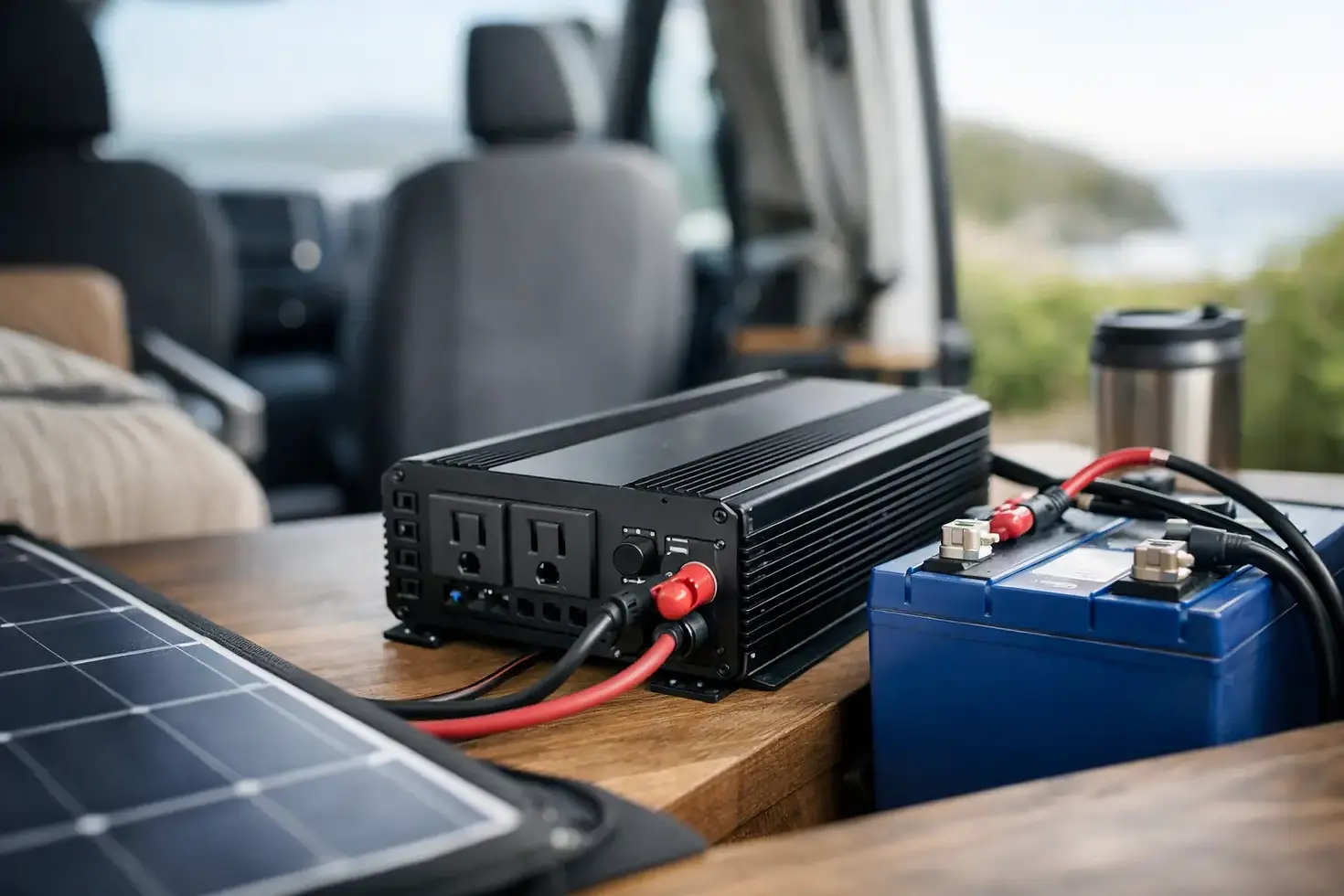
Best Power Inverters for Vans: What to Specify

A van inverter that runs a laptop but shuts down when a technician starts a cordless-tool charger is not sized for the job. The best power inverters for vans are selected around the actual electrical load, the available battery capacity, charging strategy, and duty cycle - not simply the largest wattage printed on the carton.
For commercial vans, service vehicles, mobile workshops, specialty builds, and temperature-managed applications, inverter selection affects uptime. A poor match can create low-voltage shutdowns, nuisance faults, shortened battery life, heat buildup, and equipment damage. The right unit supplies stable AC power while fitting the vehicle's DC electrical system and operating routine.
Best Power Inverters for Vans Start With the Load
Begin with an equipment list. Include every AC device that may operate at the same time, not just the largest individual tool. Typical loads include laptops, communications equipment, battery chargers, diagnostic devices, printers, small pumps, work lights, refrigeration controls, and power tools.
Each device should have a rated running wattage. Add the simultaneous running loads, then account for startup demand. Motors, compressors, pumps, and some battery chargers can draw substantially more power for a short period when starting. This is the surge load, and it is where undersized inverters often fail.
A 1,000-watt inverter may be adequate for electronics, chargers, and modest intermittent loads. A 2,000-watt pure sine wave unit is often a practical range for many work vans with multiple chargers and tools. Larger 3,000-watt systems are appropriate only when the battery bank, cabling, protection, charging system, and operating need support them. More inverter capacity is not automatically better. Larger units can have higher idle consumption, greater DC current requirements, and more demanding installation needs.
It also helps to distinguish a short-duration load from a continuous one. A microwave used for several minutes and a heater operating for hours place very different demands on the battery bank. Resistive heating appliances, coffee makers, air fryers, and portable air conditioners can drain a typical van auxiliary battery system quickly. Where possible, move high-heat or long-runtime loads to shore power, a generator, or a purpose-built high-capacity electrical system.
Use Pure Sine Wave for Professional Equipment
For most commercial van applications, pure sine wave is the preferred inverter output. It closely resembles utility power and supports a wider range of electronic equipment, variable-speed tools, sensitive chargers, communications devices, and appliance controls.
Modified sine wave inverters are less expensive, but the initial savings can be outweighed by compatibility issues. Some equipment may run hotter, make audible noise, charge poorly, or refuse to operate. They are generally a poor fit for vehicles carrying electronic test equipment, medical-support equipment, premium battery chargers, or controls associated with mobile HVAC and refrigeration systems.
The inverter's continuous rating and surge rating should both be clearly stated. A high peak rating does not compensate for inadequate continuous capacity. Specify for the real workload first, then leave reasonable margin for startup demand and future equipment changes.
Match Inverter Size to the DC System
An inverter converts low-voltage DC into 120-volt AC, but the input current on the DC side is significant. At 12 volts, a 2,000-watt AC load can require roughly 185 to 200 amps after allowing for inverter losses. At 3,000 watts, the demand can exceed 275 amps. Those currents drive decisions about battery chemistry, cable size, fuse selection, disconnects, and mounting location.
A starting battery is not an inverter battery. It is designed to provide high current briefly for engine starting, then receive a recharge. Repeated deep discharge from inverter loads can reduce its service life and may leave the vehicle unable to start. Vans intended to support substantial AC loads should use a dedicated auxiliary battery bank, with an isolation and charging strategy suited to the vehicle.
Lithium iron phosphate batteries are common in modern upfits because they offer usable capacity, efficient charging, and low voltage drop under load. They also require compatible charging controls and a battery management system appropriate for the installation. AGM batteries remain useful in certain applications, but they provide less usable capacity at high discharge rates and are considerably heavier for the same practical energy reserve.
Battery capacity is measured in watt-hours as well as amp-hours. A 12-volt, 200-amp-hour lithium battery bank contains approximately 2,400 watt-hours of nominal energy, but available runtime is lower once inverter losses, battery reserve, temperature, and real operating conditions are considered. A 1,500-watt load can consume that reserve far faster than many operators expect.
For routine engine-off operation, plan charging at the same time as inverter capacity. Alternator charging may be sufficient for light, intermittent use, especially when managed through a properly rated DC-to-DC charger. Frequent high-load operation may require higher-output alternator capacity, shore-power charging, solar support, or a combination of sources. The charging system must restore the energy taken out during a normal work cycle.
Inverter or Inverter Charger?
A standalone inverter supplies AC from the battery bank. An inverter charger adds a battery charger and transfer capability for shore power, making it useful when a van regularly returns to a facility, connects at job sites, or is used as a mobile workspace for extended periods.
With an inverter charger, AC loads can operate from shore power when connected, while the battery bank charges under controlled conditions. The changeover function should be evaluated for the intended circuits and loads. Fleet and upfit applications also benefit from remote displays or network monitoring, which allow operators to see battery state, output load, faults, and charging status without accessing the equipment compartment.
Installation Details Determine Reliability
Inverter performance is only as dependable as the installation. The unit should be mounted in a dry, protected location with the ventilation clearance required by its manufacturer. It should not be installed in an unventilated battery compartment unless it is specifically rated for that environment. Heat reduces efficiency and can lead to thermal shutdown during heavy demand.
DC cable runs should be short, correctly sized for the inverter's maximum input current, protected from abrasion, and terminated with properly crimped lugs. The positive conductor needs overcurrent protection located close to the battery source. A properly rated disconnect is also valuable for service, emergency isolation, and seasonal storage.
Follow the inverter manufacturer's instructions for grounding, bonding, neutral configuration, and AC branch-circuit protection. Vehicle DC negative, chassis grounding, and AC neutral bonding are related but not interchangeable concepts. Incorrect bonding can create shock hazards, fault-protection problems, or equipment damage. For installations with multiple AC circuits, shore power, generators, or higher-capacity battery systems, use a qualified vehicle upfitter or mobile electrical technician.
Pay attention to idle draw as well. An inverter left on overnight can consume meaningful energy even when no equipment is connected. Low-power search modes can help in some applications, but they may not recognize every small electronic load. If communications equipment, refrigeration controls, or monitoring systems require uninterrupted AC power, calculate the inverter's standby consumption into the total energy budget.
Specify for the Vehicle's Actual Workday
The right inverter for a plumber's service van may be very different from the right system for a mobile clinic, command vehicle, refrigerated delivery support unit, or field-service workshop. A technician who charges two tool batteries between calls needs a different system than a crew operating a printer, diagnostic station, communications rack, and portable equipment for an eight-hour shift.
Before ordering, document the AC loads, their runtime, simultaneous operation, startup requirements, battery chemistry and capacity, charging sources, available mounting space, and desired outlet locations. Confirm whether the vehicle needs only occasional AC power or a managed electrical system that can support daily engine-off work.
For van builds that also depend on climate-control, heating, refrigeration, or other thermal equipment, power planning should be coordinated early. KABAIR supports application-focused vehicle systems, helping buyers consider the component choices that affect fitment, service access, and operational performance.
A dependable inverter system is not defined by a single wattage number. Specify the unit around the load profile, then build the battery, charging, cable, and protection system to support it. That approach keeps the van productive when the engine is off and the work still needs to continue.


Comments