

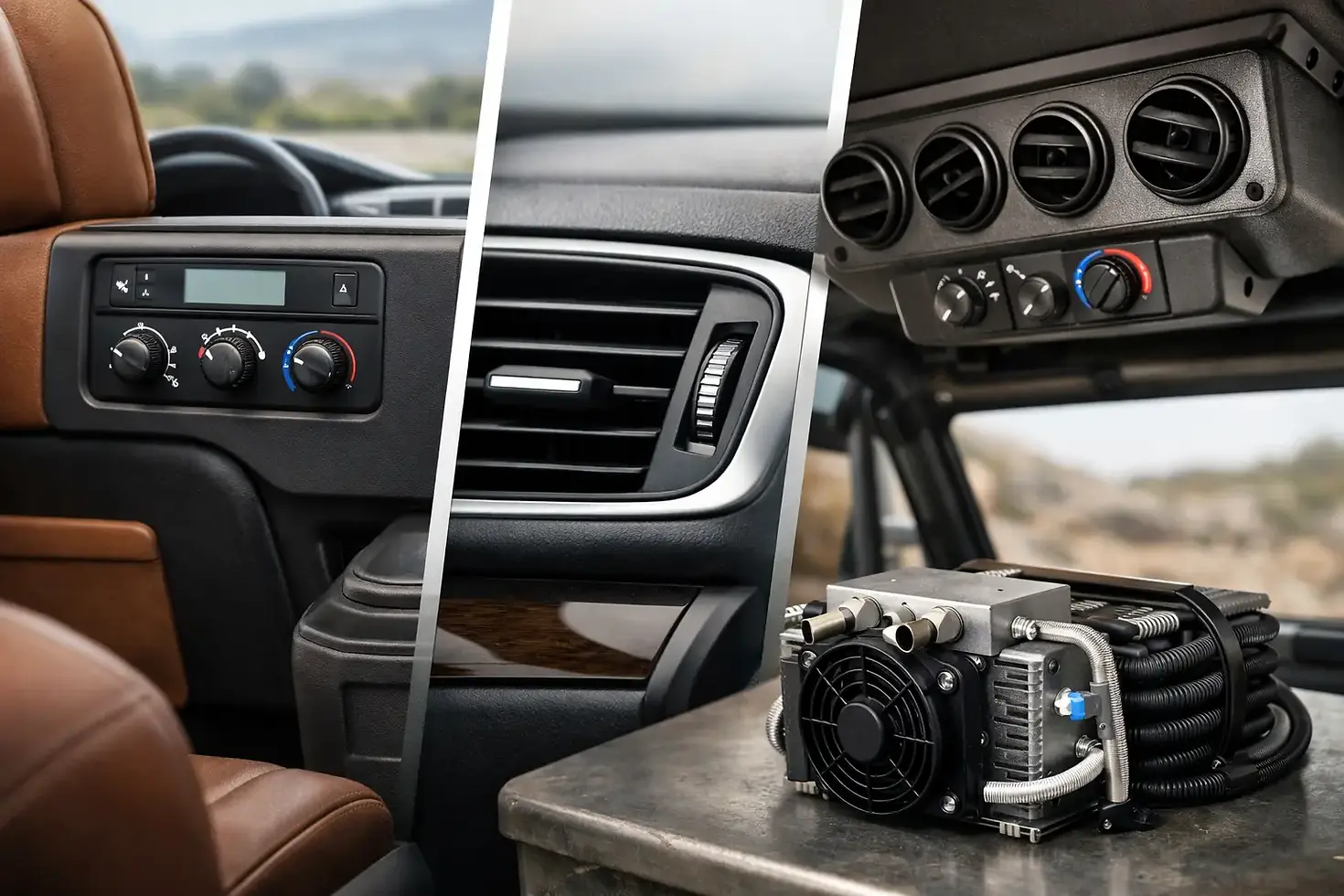
Custom Vehicle Climate Solutions That Fit

A work van idling on a summer jobsite, a service truck starting before dawn in January, and a refrigerated unit moving temperature-sensitive cargo all have the same operational reality - climate control is not a convenience item. It is a system that affects uptime, operator performance, equipment protection, and delivery quality. That is why custom vehicle climate solutions matter. Standard off-the-shelf components can work in some cases, but once duty cycle, cabin layout, cargo requirements, or power limitations change, fitment and system design become the difference between acceptable and dependable.
Why custom vehicle climate solutions are often the better fit
Vehicle climate systems have to perform in a moving environment with changing loads, vibration, limited installation space, and wide ambient temperature swings. A package that works in a passenger application may fall short in a utility body, sleeper cab, enclosed service van, shuttle, ambulance, off-road unit, or refrigerated vehicle conversion.
Custom vehicle climate solutions address those variables directly. Instead of forcing a generic system into a specialized platform, the equipment is selected around the vehicle, the operating conditions, and the thermal demand. That can mean matching evaporator size to cabin volume, choosing heating capacity for cold-start performance, adding filtration for air quality needs, or integrating power components that support climate equipment without overloading the electrical system.
The payoff is usually practical. Drivers stay productive, cargo stays within range, and service intervals become more predictable. The trade-off is that custom work requires more attention up front. Buyers need accurate vehicle information, a clear understanding of use case, and confidence that parts and support will still be available later.
Start with the application, not the part number
The most common mistake in vehicle HVAC planning is starting with a product before defining the application. Commercial buyers usually know the symptom - weak cooling, poor air movement, uneven heat, or inadequate temperature hold - but the root cause may not be a single failed component. It may be system undersizing, poor airflow path, insulation loss, a changing interior layout, or electrical capacity that no longer matches the installed equipment.
For that reason, application details matter more than broad vehicle category labels. Two vans from the same model year can require very different solutions if one is used for parcel delivery and the other has been converted into a mobile service unit with partitions, racks, tools, and auxiliary power loads. The same is true for trucks with sleeper areas, work bodies, or enclosed cargo spaces.
A sound specification process usually begins with vehicle make and model, cabin or box dimensions, insulation level, expected ambient conditions, occupancy, idle time, and whether the system must cool people, protect equipment, control cargo temperature, or handle some combination of all three. Once those factors are clear, component selection becomes faster and more accurate.
Cabin comfort and operator performance
For fleet managers and service operators, cab climate control is tied to more than comfort. Heat stress and cold exposure affect concentration, fatigue, and willingness to keep vehicles in service during extreme weather. In practical terms, a driver who cannot cool down between stops or maintain visibility because of poor defrost performance is operating at a disadvantage.
Custom sizing helps here because cabin volume, glass area, door cycling, and equipment partitions all change thermal load. A larger evaporator or improved airflow distribution may solve a problem that repeated compressor replacement never touched. In cold-weather applications, heater output and circulation can matter just as much as cooling capacity.
Cargo protection and temperature stability
When the load matters as much as the driver, system design gets more specific. Refrigerated transport, temperature-sensitive tools, electronics, and field-service inventory can all require controlled conditions. The required temperature band, pull-down time, and door-open frequency will determine whether a standard mobile A/C setup is enough or whether dedicated reefer equipment and related components are the better choice.
This is one of the clearest cases where custom vehicle climate solutions earn their cost. An undersized system may seem acceptable during mild weather, then fail during peak summer routes. An oversized system can create short cycling, unnecessary power draw, or poor moisture control. The right answer depends on duty cycle and cargo risk, not just nameplate capacity.
Key system categories that shape performance
Most commercial buyers are not purchasing a climate system in isolation. They are managing an interconnected set of components that must fit the vehicle and work together under load.
Air conditioning remains the most visible category, but cooling performance depends on more than the compressor. Condensers, evaporators, controls, blowers, hoses, fittings, and mounting approach all influence output and serviceability. In a custom build, packaging is often half the challenge.
Heating products are equally critical in many regions and vehicle types. Supplemental heaters, engine-off heating options, and fit-specific replacement components can all solve cold-weather performance issues that a general replacement part will not address.
Air filtration is sometimes overlooked until operators start dealing with dust, odors, or high-particulate jobsite conditions. Better filtration can improve cabin air quality and support HVAC efficiency, especially in work vehicles exposed to construction debris, road grime, or repeated door openings.
Energy equipment also deserves attention. If the vehicle conversion includes added thermal loads, idle reduction goals, or auxiliary electrical demand, the power side has to support the climate side. That may involve batteries, charging components, or other supporting equipment selected around the total system requirement.
Fitment accuracy is not a small detail
In commercial service, a climate component that is almost right often becomes expensive. Incorrect hose routing, bracket mismatch, poor mounting clearance, and incompatible electrical connections add labor, delay installs, and increase the chance of repeat service. For fleet environments, that cost multiplies quickly across units.
This is why fitment tools and application-based part selection matter. Vehicle search and part search functions reduce guesswork, especially when buyers are balancing replacement needs against modified or converted vehicle configurations. They do not eliminate the need for technical review in every case, but they create a much better starting point than broad cross-reference shopping.
There is also a long-term maintenance advantage. When the original selection is documented against the vehicle and application, future replacement becomes more straightforward. Service centers can source recurring items faster, and fleet managers can standardize around components that have already proven reliable in the field.
When custom design makes the most sense
Not every vehicle needs a fully engineered climate package. If a unit is close to stock and the operating demand is ordinary, a fit-specific replacement may be enough. But several conditions usually point toward a custom approach.
One is vehicle conversion. Once a platform has been changed for trade work, emergency response, delivery, passenger transport, or specialty service, the factory climate assumptions no longer apply. Another is severe duty. High idle time, extreme ambient temperatures, dirty operating environments, and frequent stop-and-go cycles all place extra stress on the system.
Custom design also makes sense when the cost of failure is high. That includes cargo spoilage, operator downtime, field equipment exposure, or service interruptions tied directly to thermal performance. In those cases, the question is less about lowest acquisition cost and more about total operational impact.
For buyers managing multiple vehicle types, a supplier with broad category coverage can simplify the process. Sourcing A/C, heating, reefer, filtration, and related components through one channel can reduce procurement friction and improve support continuity. That matters when replacements, upgrades, and service requests all have to move quickly.
What to evaluate before you buy
Before selecting a system or replacement path, it helps to pressure-test the application with a few direct questions. Is the problem limited to a failed part, or has the vehicle outgrown its original climate setup? Is the priority driver comfort, cargo integrity, air quality, or all three? Does the electrical system support the climate equipment you intend to run? And can the installed components be serviced efficiently once the vehicle goes back into operation?
Those questions are not theoretical. They affect installation time, future parts availability, and whether the solution will still be working when peak season arrives. A lower-cost option can be valid in the right scenario, but only if it actually matches the thermal load and service conditions. If it does not, the savings usually disappear into callbacks, downtime, and shortened component life.
For commercial buyers, the strongest climate solution is rarely the one with the loudest claims. It is the one specified around the real vehicle, the real work cycle, and the real consequences of failure. That is the value of a supplier built around fitment accuracy, product depth, and responsive support, whether the need is a direct replacement or a more specialized build through a source like KABAIR.
The best time to solve a vehicle climate problem is before it becomes a route failure, a cargo loss, or a driver complaint that keeps repeating. If the application is specialized, treat it that way and buy the system that fits the work.


Comments